
Regime Detection (Free TradingView Indicator)
A free TradingView indicator that identifies trading regimes using volatility-based analytics so you can align your strategy with current market conditions and avoid unfavorable setups.
- •Shows on-chart status table with long/short/flat signals
- •Detects trend, range, and transition regimes using volatility patterns
- •Provides instant visual feedback about favorable trading conditions
Who it's for:
- ✓Traders who want to know when conditions favor long, short, or staying flat
- ✓Anyone using other indicators who needs regime context as a filter
Not ideal for:
- ✗Traders who want specific entry/exit signals (this is a filter, not a signal generator)
- ✗Scalpers who need tick-by-tick precision (this focuses on regime quality, not micro-timing)
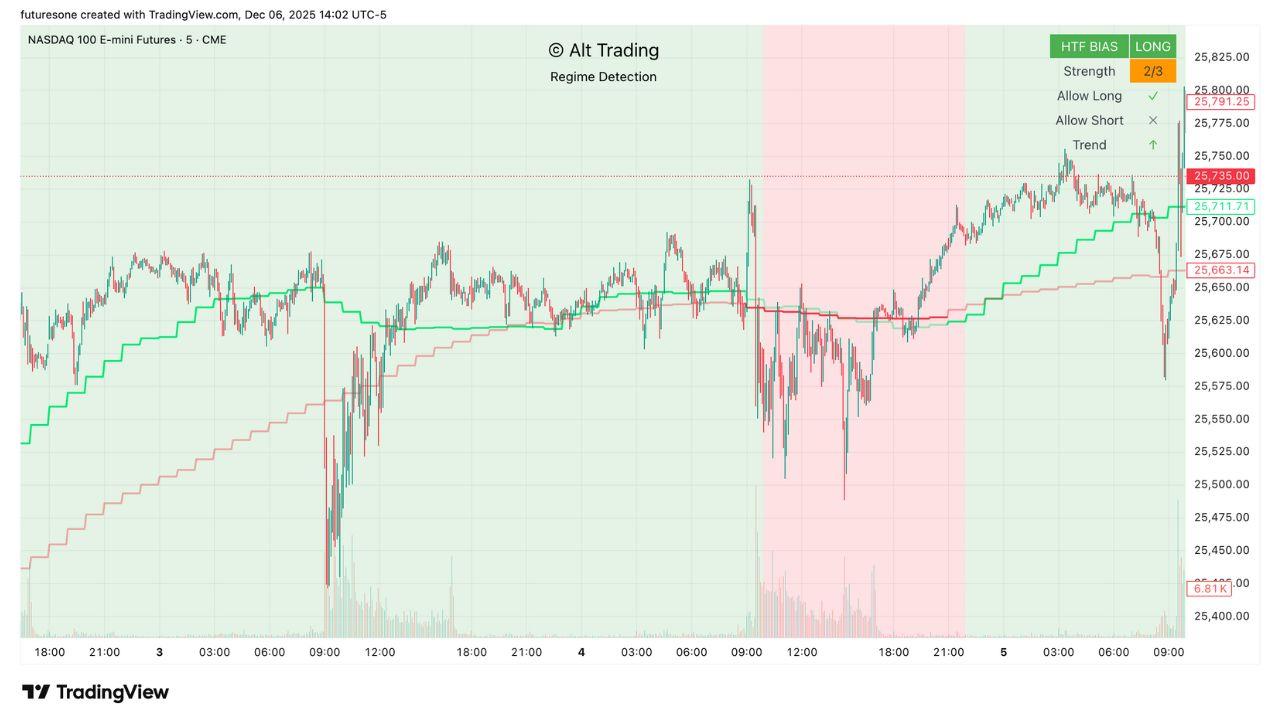
What you get on the chart
- •Status table: On-chart display showing current regime (Long/Short/Flat) with color coding
- •Regime labels: Text indicators for trend, range, or transition states
- •Volatility metrics: Background calculations that drive regime detection (not always visible, but configurable)
- •Transition alerts: Visual indicators when regime shifts occur (optional)
How to use it
Best timeframes
Works on any timeframe, but most useful on 15m, 1h, and 4h charts where regime transitions are meaningful. Lower timeframes (1m/5m) may show too many transitions.
Best markets
Optimized for ES, NQ, CL, GC, and YM futures. Works on any liquid market with clear volatility patterns.
Default workflow
- Check status table for current regime (Long/Short/Flat)
- If "Long" regime: focus on bullish setups, avoid shorts
- If "Short" regime: focus on bearish setups, avoid longs
- If "Flat" regime: stay out or trade very selectively (conditions unclear)
- Use as a filter with other indicators (only take signals that align with regime)
Common mistakes
- Trading against the regime (taking shorts in "Long" regime, etc.)
- Ignoring "Flat" signals and forcing trades anyway
- Using on very low timeframes where regime changes too frequently
- Expecting entry/exit signals (this is a filter, pair it with other tools)
Settings guide
Volatility lookback
How many bars to analyze for volatility patterns. Longer = more stable but slower to react. Default: 20 bars.
Regime sensitivity
Threshold for regime transitions. Higher = fewer transitions (more stable), lower = more transitions (more reactive). Default: Medium.
Status table position
Where the status table appears on chart (top-left, top-right, etc.). Default: Top-right.
Transition alerts
Enable/disable visual alerts when regime changes. Default: Enabled.
Examples
Example: Long regime with bullish setups
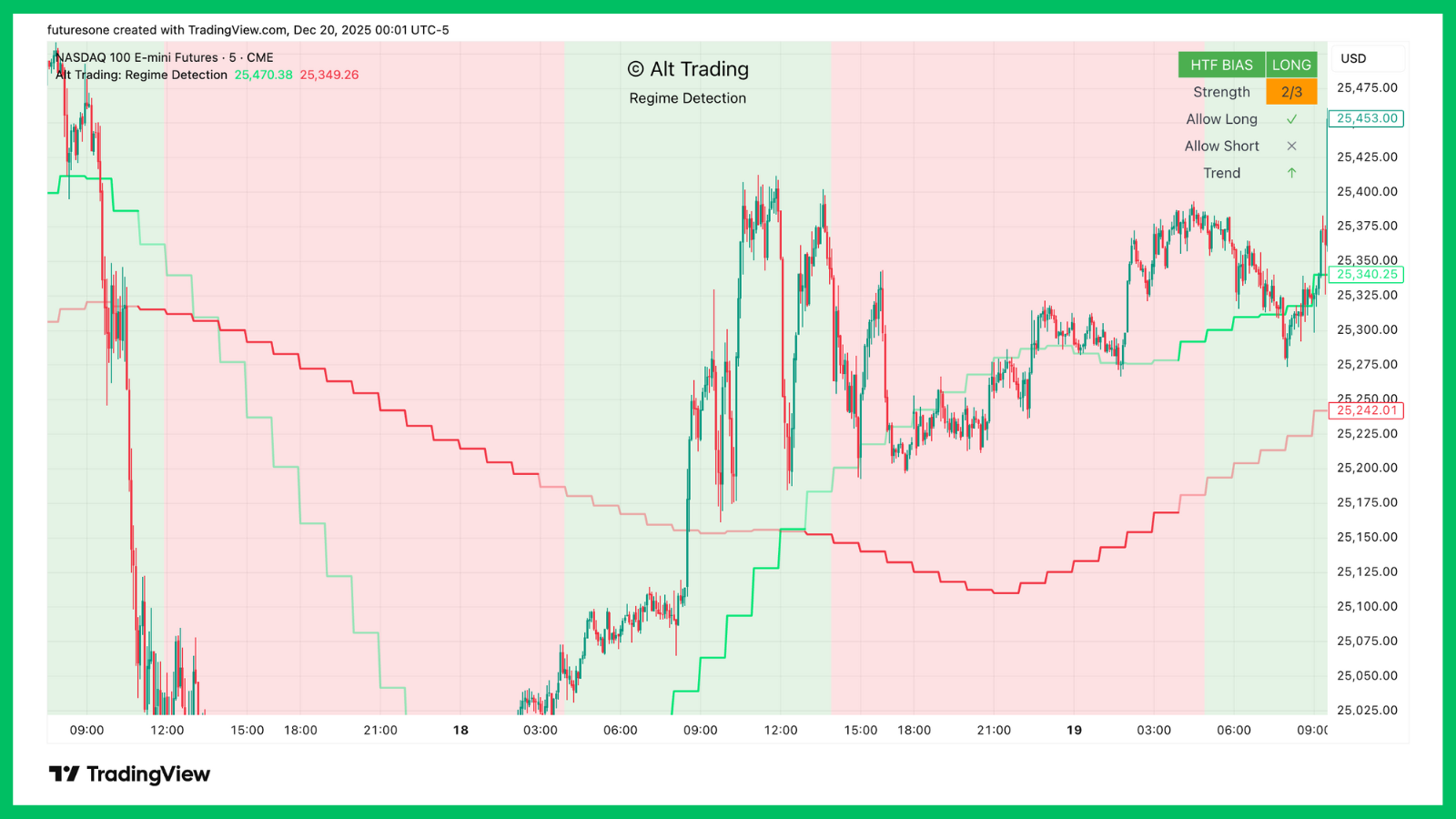
Status table shows "Long" regime (green). Volatility patterns indicate trending conditions. This is the time to focus on bullish setups and avoid shorts. Other indicators' long signals are more reliable during this period.
Example: Flat regime = stay out
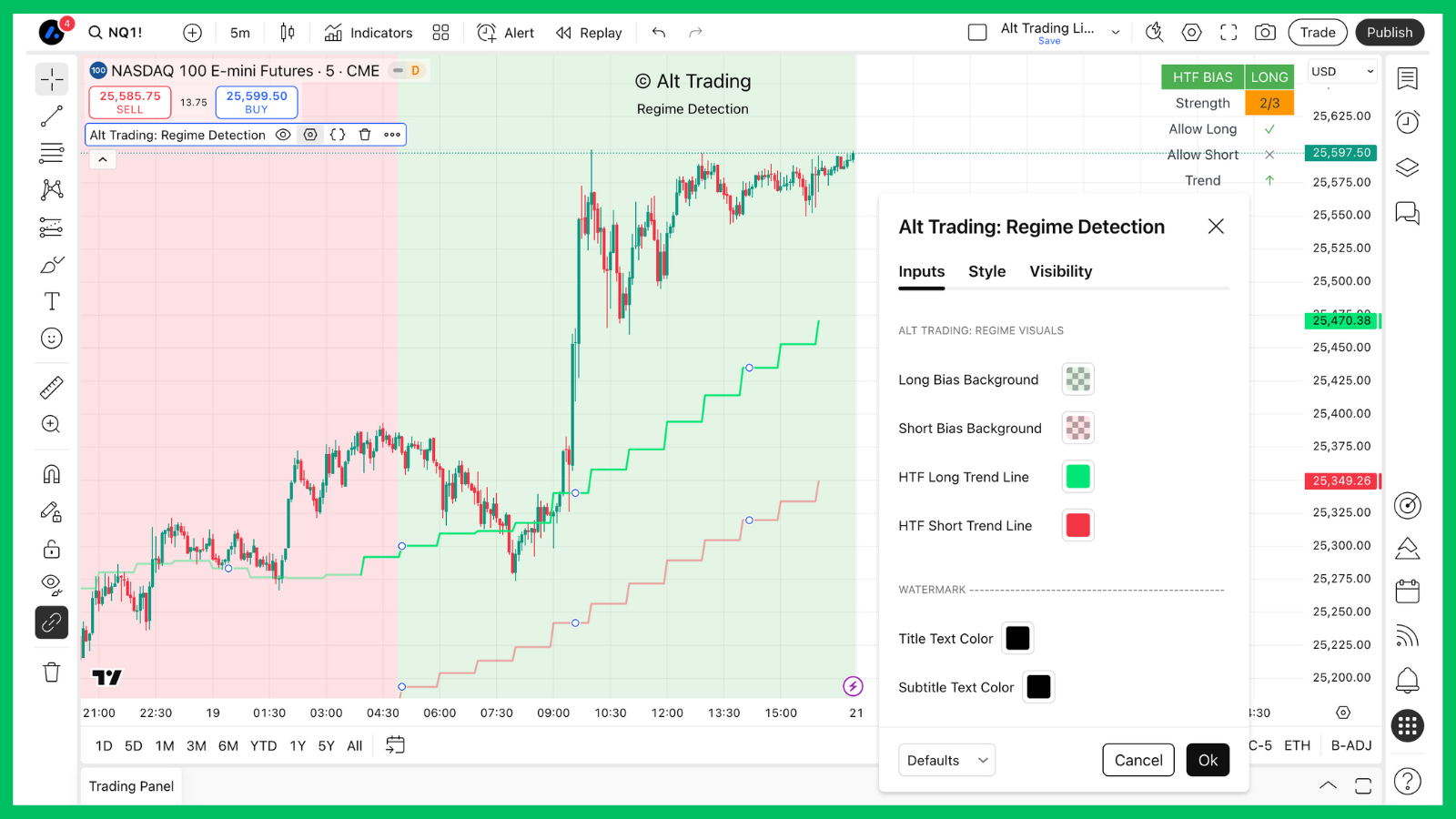
Status table shows "Flat" regime (gray/yellow). Volatility is low and structure is unclear. This is a "stay out" signal—conditions don't favor either direction. Indicator correctly identifies when it's better to wait.
Limitations / what it's NOT
When it works: Clear trending or ranging markets, during normal volatility conditions, when paired with other indicators as a filter.
When it fails: During extreme volatility spikes (news events), in very choppy markets without clear structure, during low liquidity periods.
What it doesn't claim: This is a filter, not a signal generator. It tells you when conditions favor long/short/flat, but doesn't give specific entry/exit points. You still need other tools for actual trade execution.
Repainting: Regime detection uses volatility calculations that may adjust slightly as new bars form, but confirmed regime states remain stable. Status table updates in real time based on current conditions.
Why we built this
Most traders use indicators that generate signals, but they don't know when those signals are more or less reliable. Regime Detection solves this by telling you the quality of current market conditions—so you can filter your other tools and avoid trading when the odds are against you.
The volatility-based approach is more objective than trend lines or moving averages—it measures actual market behavior, not just price position relative to arbitrary levels.
Best paired with: Tom's Reversal Strategy (for reversal signals) or Technical Analysis (for structure levels).
Version History
v1.1 (Nov 24, 2025)
Initial release with volatility-based regime detection and on-chart status table.
FAQ
What makes Regime Detection different from trend indicators?
It uses volatility-based analytics to identify trading regimes, providing clear signals about when conditions favor long setups, short setups, or staying flat. The on-chart status table makes this information instantly accessible. It's more objective than trend lines because it measures actual market behavior.
How can I use this indicator with my trading strategy?
Use it as a filter with other indicators. If status shows "Long" regime, only take long signals from your other tools. If it shows "Flat," stay out or trade very selectively. This improves the quality of your entries by avoiding unfavorable conditions.
Does this give entry/exit signals?
No, this is a filter, not a signal generator. It tells you when conditions favor long/short/flat, but you need other indicators for actual entry/exit points. Pair it with tools like Tom's Reversal Strategy or TX Price Action.
How can I access Regime Detection?
You can get access to the Regime Detection indicator directly from the Alt Trading Library, available for TradingView, completely free. Claim free access here.
What markets and timeframes work best?
Optimized for ES, NQ, CL, GC, and YM futures. Works best on 15m, 1h, and 4h charts where regime transitions are meaningful. Avoid very low timeframes (1m/5m) where regime changes too frequently.
Related Alt Trading Indicators
- Tom's Reversal Strategy - Hourly bias + BOS confirmation with blue window timing
- Technical Analysis - Essential intraday levels (CDH/CDL, PDH/PDL, FVGs)
- TX Price Action - Market structure + liquidity sweeps with BOS detection
Want signals + execution rules?
FuturesOne includes B1 (breakout), P1 (pivots), and S1 (swing) systems with regime filters and risk management. $49/mo per system.
View FuturesOne PlansWant evolving research + weekly updates?
Alt Trading Lab includes all 3 FuturesOne systems (B1 + P1 + S1) plus ongoing research updates. $99/mo.
Join Alt Trading Lab